BLUF: EU AI Act readiness for AI automation is an engineering problem before it is a legal file. If an AI workflow can influence access, safety, employment, credit, critical operations, or regulated decisions, teams need traceable logs, versioned technical documentation, human oversight records, and post-deployment monitoring. This article is practical engineering guidance, not legal advice; final interpretation and risk classification need counsel and the responsible compliance owner.
The mistake I see in B2B automation projects is treating compliance evidence as a PDF produced at the end. That fails in production. Evidence must be emitted by the system while it runs: prompts, model versions, retrieval sources, tool calls, approvals, overrides, incidents, evaluation results, and changes to risk controls. Without that telemetry, you cannot reliably explain why an automation acted, who approved it, or whether drift changed the risk profile.
Why logging and documentation belong in the architecture
Regulation (EU) 2024/1689, the EU AI Act, describes technical documentation for high-risk AI systems in Article 11 and automatic event logging in Article 12. Article 12 requires high-risk systems to technically allow automatic recording of relevant events over their lifetime, with traceability suitable for the intended purpose. Article 26 also places obligations on deployers, including using systems according to instructions, assigning human oversight, monitoring operation, and keeping logs where under their control. The implementation detail is not solved by the regulation; it must be designed into your stack.
For automation teams, the practical implication is simple: every meaningful AI action should create an evidence packet. The packet should connect business context, data inputs, model and tool behavior, human decisions, and output delivery. If the system can write into CRM, ERP, ticketing, HR, finance, procurement, or production systems, an audit trail is not optional operational hygiene.
A production-ready evidence architecture
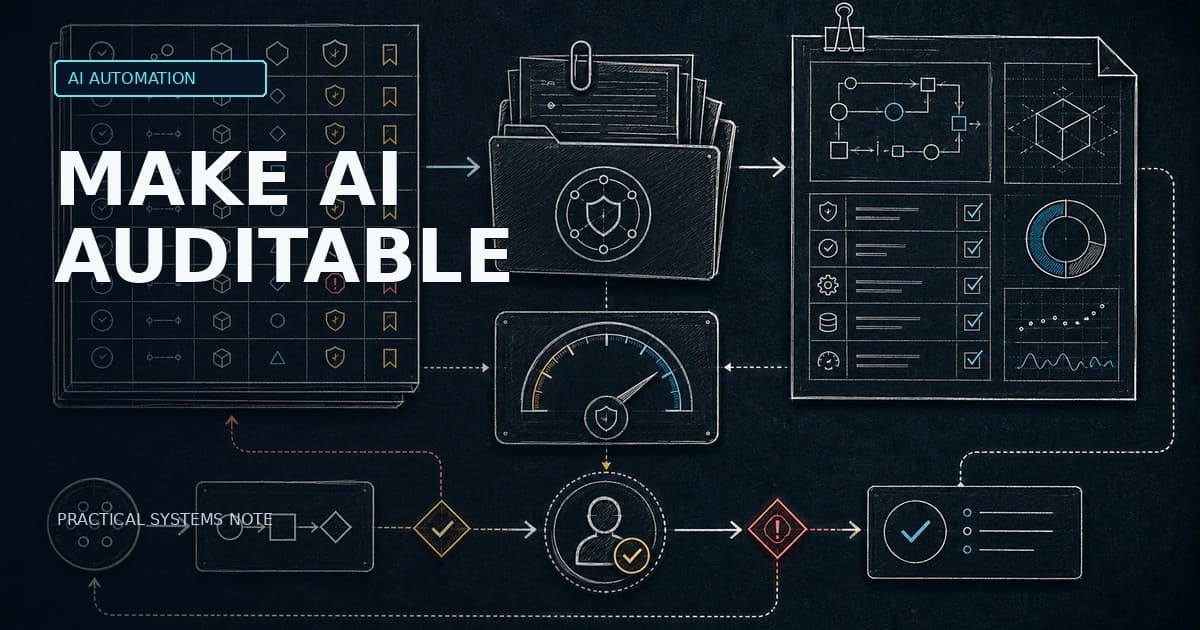
Diagram — AI automation evidence flow: user request -> policy/risk classifier -> retrieval and tool plan -> model/tool execution -> human approval gate where required -> system action -> log store, evaluation store, documentation repository, and incident/post-market monitoring dashboard.
The control plane should sit next to the automation runtime, not inside a slide deck. In practice this means your n8n workflow, LangGraph state machine, or backend service emits structured events to a central log pipeline. Each event carries correlation IDs, tenant or process IDs, policy decision IDs, model version, prompt template version, tool schema version, data-source references, approval status, and result classification.
For low-risk internal productivity bots, this may be lightweight. For high-impact or potentially high-risk workflows, it should be designed like a regulated production system: immutable logs, access controls, retention policy, change management, incident escalation, and reproducible evaluation snapshots. You do not need to over-engineer every chatbot, but you do need an explicit risk boundary.
Implementation matrix: what to log
| Table — Control area | Minimum event data | Why it matters |
|---|---|---|
| Request intake | user or system actor, timestamp, business process, input channel, purpose, consent or policy basis where relevant | establishes context and scope. |
| Data and retrieval | data source IDs, document versions, retrieval query, top evidence references, access filter decision | shows which information grounded the output and whether permissions were respected. |
| Model execution | model name and version, prompt template version, parameters, safety settings, output hash, latency, token cost | supports reproducibility, cost control, and drift analysis. |
| Tool calls | tool name, schema version, input payload hash, external system target, response status, error class | explains how the AI touched business systems. |
| Policy gates | risk classification, rule version, blocked action, required approver role, escalation reason | proves controls were applied before impact. |
| Human oversight | approver identity or role, evidence shown, decision, timestamp, override reason | makes human-in-the-loop review auditable rather than symbolic. |
| Post-action monitoring | downstream write ID, rollback link, user feedback, incident flag, evaluation result | connects live operation to monitoring and continuous improvement. |
Technical documentation should be generated, not hand-written once
Article 11 points to documentation that demonstrates conformity before a high-risk AI system is placed on the market or put into service and keeps it up to date. In engineering terms, documentation should be versioned with the system. A practical documentation repository contains system purpose, intended users, risk classification rationale, architecture, data lineage, evaluation plan, human oversight design, logging specification, cybersecurity assumptions, known limitations, and operational monitoring procedures.
A strong pattern is docs-as-code plus runtime evidence. Store architecture decisions, model cards, data-source descriptions, risk assessments, test reports, prompt/tool versions, and runbook changes in Git or a controlled document system. Link each deployed version to CI results, evaluation reports, and observability dashboards. The document then becomes an index to real controls, not a narrative detached from production.
Documentation checklist for AI automation
1. System description: business process, users, environments, system boundaries, and external dependencies.
2. Data governance: data sources, access controls, retention, quality checks, personal-data handling, and known blind spots.
3. Model and tool design: model providers, prompt templates, tool schemas, workflow state, fallback paths, and deterministic business rules.
4. Risk management: foreseeable misuse, failure modes, severity, likelihood, mitigations, and residual risk owners.
5. Human oversight: approval thresholds, reviewer roles, evidence packet design, override policy, and escalation paths.
6. Evaluation: offline test sets, online monitoring metrics, red-team cases, regression thresholds, and acceptance criteria.
7. Logging and monitoring: event taxonomy, retention, immutability, access policy, alerting, incident response, and review cadence.
Where teams usually fail
The first failure mode is incomplete traceability. A ticket says “AI suggested remediation,” but the log does not show the retrieved documents, tool response, prompt version, or approval basis. That is not enough for operations, and it is weak evidence for compliance.
The second failure mode is over-logging sensitive payloads. Logging every prompt and response verbatim may create privacy and security risk. Use structured metadata, hashes, redaction, field-level encryption, and short retention for sensitive content. Keep enough evidence to explain behavior without turning the log store into a second uncontrolled data lake.
The third failure mode is treating human oversight as a button. A reviewer needs the evidence packet: what the system saw, what it intends to do, confidence and risk signals, alternatives considered, and rollback options. If the approval screen only shows “Approve / Reject,” the human is present but not meaningfully equipped.
Reference architecture for Mittelstand and enterprise teams
A pragmatic stack does not require a separate governance platform on day one. Start with a workflow runtime, structured event schema, central log store, evaluation harness, and documentation repository. Add policy engines, immutable storage, and compliance dashboards when the risk and scale justify them.
| Table — Component | Lightweight start | Production hardening |
|---|---|---|
| Workflow runtime | n8n or LangGraph with explicit states | backend orchestration with idempotency, retries, and separation of duties. |
| Event schema | JSON events with correlation IDs | governed schema registry, versioned contracts, and automated validation. |
| Log storage | restricted database or observability platform | append-only storage, WORM/immutability where required, retention and legal hold controls. |
| Evaluation | curated test cases and manual review | continuous online evals, regression gates, synthetic adversarial cases, and cost/error budgets. |
| Documentation | Git repository with templates | controlled document management linked to releases, risk reviews, and incident records. |
Metrics that prove readiness
Compliance preparation becomes much more concrete when measured. Track audit completeness rate, approval-gate coverage, unexplained-action rate, log redaction failure rate, evaluation regression rate, mean time to reconstruct an incident, percentage of workflows with named risk owners, and percentage of deployments linked to updated documentation. These metrics are more useful than a binary “AI Act ready” claim.
For cost control, also track tokens, model calls, tool failures, queue time at approval gates, and rollback frequency. Good logging should help the CTO and Head of AI answer both questions: “Are we safe enough?” and “Is this automation economically worth running?”
A 30-day implementation plan
Week 1: inventory AI automations and classify impact. Identify workflows touching regulated, safety-critical, employee, customer, financial, or production decisions. Assign an owner and define the evidence needed to explain each workflow.
Week 2: implement a shared event schema. Add correlation IDs, workflow state transitions, model/tool versions, retrieval references, policy decisions, and approval records. Redact sensitive fields before storage.
Week 3: connect documentation to releases. Create system cards, risk registers, model/tool change logs, evaluation reports, and oversight runbooks. Link each production version to its documentation snapshot.
Week 4: test reconstructability. Pick five real runs and one simulated incident. Can your team reconstruct what happened, why it happened, who approved it, what changed since the previous release, and how to roll it back? If not, fix the evidence path before expanding automation scope.
Sources
Regulation (EU) 2024/1689, EU AI Act — Article 11 on technical documentation: https://artificialintelligenceact.eu/article/11/
Regulation (EU) 2024/1689, EU AI Act — Article 12 on record-keeping and automatic event logs: https://artificialintelligenceact.eu/article/12/
Regulation (EU) 2024/1689, EU AI Act — Article 26 on deployer obligations including monitoring and log retention where under control: https://artificialintelligenceact.eu/article/26/
NIST AI Risk Management Framework — Govern, Map, Measure, Manage functions for operational AI risk management: https://www.nist.gov/itl/ai-risk-management-framework
How Ade can help
If you are building AI automation in a German B2B environment, the useful starting point is not a generic compliance workshop. It is a technical evidence review: map one workflow, inspect the logs, check approval gates, review documentation, and verify whether an incident can be reconstructed. Ade helps teams design these control planes around real n8n, LangGraph, backend, RAG, and production monitoring constraints, so the system remains useful while becoming auditable.