
BLUF — test the intervention path with the ordinary interface unavailable, not just with a working stop button. For a non-safety-critical AI advisory service, a useful acceptance criterion is observable: the assigned operator can fence new admission, prevent queued advice from becoming executable and identify unresolved work through a management path that does not depend on the failed UI session. Requested, acknowledged and effective are different facts. A successful HTTP response proves none of them beyond its defined contract.
This article includes an executed localhost experiment with two HTTP listeners and synthetic advice. It tests software-state transitions under injected interface and session failures. It does not validate a production network, real identity provider, durable queue or safety function. The physical mechanism in the cover is an illustration of a control boundary, not a design for an emergency stop.
Start with the failure that defeats the operator
Consider a service that suggests a support-ticket routing decision. The operator notices advice outside its permitted scope. The web application is unavailable, or its login session has expired. If the intervention control uses the same application route and session, the operator's authority exists on paper but cannot currently be exercised.
A second button on the same broken page is not a second channel. Neither is a command-line tool that calls the same unavailable gateway. Draw the dependencies from operator workstation to authoritative admission gate: name resolution, routing, proxy, identity verification, authorisation, control handler, state store and worker enforcement. Mark which are shared. Independence is always relative to a named failure; a separate listener in one process does not survive that process failing.
The foundational supplier-instruction acceptance test asks whether the operator can execute the documented procedure. This follow-on asks a narrower question: can that intervention still reach its enforcement point when the ordinary presentation or authentication path is degraded? It is not another generic oversight checklist.
Legal context is a boundary, not a certification claim
For high-risk systems within the relevant scope, Article 14 of the consolidated AI Act addresses effective human oversight. Paragraph 4 includes the ability, as appropriate and proportionate, to disregard, override or reverse outputs and to intervene or interrupt operation through a stop button or similar procedure that permits a halt in a safe state. Article 26(2) addresses assigning oversight to people with the necessary competence, training, authority and support.
Those provisions do not prescribe this article's two-listener architecture, HTTP status codes or timing thresholds. Counsel must assess classification, provider/deployer roles, current amendments, application dates and sector requirements. The consolidation is a documentation aid; the authentic legal instruments govern. This is engineering guidance, not legal advice or a conformity assessment.
NIST AI RMF 1.0 offers a voluntary risk-management framework; its MANAGE function includes mechanisms to supersede, disengage or deactivate systems exhibiting performance or outcomes inconsistent with intended use. The NIST Playbook explicitly says it is neither a checklist nor a sequence to follow in full. Neither source is an EU compliance certificate.
Define the intervention contract before building a channel
Requested means the control service received an authorised, scoped intervention request. Keep the operator's earlier attempt separately: a click that never reaches that service must not be counted as a received request. Acknowledged means a response with a defined meaning reached the client. Effective means an authoritative state probe establishes the promised boundary, including worker-side enforcement where applicable. Receipt acknowledgement can precede effect; in the local experiment, effect precedes the deliberately delayed response.
For this advisory example, the intended state is admission closed and queued advice unavailable for dispatch. That is a controlled software state, not a universal definition of a safe state. Do not claim that cancelling a request reverses an already committed business action. Record in-flight work as completed, confirmed stopped or unresolved, with an owner for reconciliation. A real workflow needs destination evidence before asserting that an external action stopped.
Use a scoped intervention identifier, operation identity, expected policy revision and idempotent retry semantics in the production contract. A timeout must lead to a status query and bounded escalation, not an automatic restart. Repeated intervention should retain the closed state. Reopening should be a separate operation with separately assigned authority and a review of held work, not a side effect of logging in again.
| Dependency / owner | Failure or decision | Required residual capability |
|---|---|---|
| UI and session / platform | UI down or ordinary session expired | Scoped management access remains usable |
| Admission and workers / service | Intervention received | Fence new work; hold queued advice |
| Evidence sink / incident lead | Evidence write fails | Keep gate closed; expose missing proof |
| Restart / named authority | Operator requests reopening | Separate review and authorisation |
The matrix is a proposed operating decision, not a legally mandated implementation. The management path still needs strong authentication, least-privilege authorisation, rate limits and auditing. Do not implement an unauthenticated backdoor in the name of availability. A separately provisioned, narrowly scoped intervention credential may reduce dependence on an interactive session; it creates its own rotation, revocation, custody and exercise obligations. Select it against your threat model rather than bypassing security controls.
What the local fault experiment actually ran
The fixture ran on Python 3.14.9 using the standard-library ThreadingHTTPServer and urllib HTTP client. Two listeners bound ephemeral ports on 127.0.0.1. They shared one process, an in-memory queue and a lock. One represented the ordinary interface path; the other the management path. Neither accepted external traffic or dispatched a real action.
Each scenario began with two synthetic queued advice items. The /intervene handler required the synthetic role operator and scope advisory-lab. Under the lock it closed admission and removed the items from the executable queue. In this toy representation removal stands for holding work; it is not a durable quarantine implementation. The /admit and /dispatch probes then checked enforcement. The /restart route always rejected requests, illustrating separation of restart rather than implementing a complete restart workflow.
The ordinary path returned an injected 503 for interface failure or an injected 401 for an expired ordinary session. These are deliberate HTTP fault responses, not tests of a browser or identity provider. Synthetic role and scope headers are test inputs only; they must never become a production authentication scheme. The management handler remained available in both cases.
| Injected scenario | Observed result | Interpretation |
|---|---|---|
| Ordinary UI unavailable | 503 ordinary; 200 management | Management intervention effective |
| Ordinary session expired | 401 ordinary; 200 management | Synthetic session failure isolated |
| Acknowledgement delayed | 409 admission before reply | Effect precedes acknowledgement |
| Evidence result failed | Gate closed; evidence=failed | No silent reopening |
| Wrong role | 403; no fence change | Unauthorised request rejected |
| Wrong scope | 403; no fence change | Scope boundary enforced |
| Coupled-path negative control | 503; admission remains open | Expected failed intervention |
All seven scenario assertions passed. In the four successful intervention scenarios, the management response was 200, late admission returned 409, dispatch reported executable=false and restart returned 403. Wrong-role and wrong-scope requests returned 403 without changing the fence. The negative control is essential: an intervention sent through the deliberately unavailable ordinary path returned 503 and left admission open. That is the expected failed intervention, not a successful stop.
For delayed acknowledgement, the handler slept for a configured 150 milliseconds after changing state. The captured monotonic timeline recorded requested at 0.785 ms, admission_fenced at 0.790 ms, queue_held at 0.792 ms, effective at 0.793 ms and acknowledged at 150.898 ms relative to scenario start. A concurrent ordinary-path admission probe was rejected before the delayed response completed. These are single-run local observations, not latency objectives, reliability estimates or production percentiles.
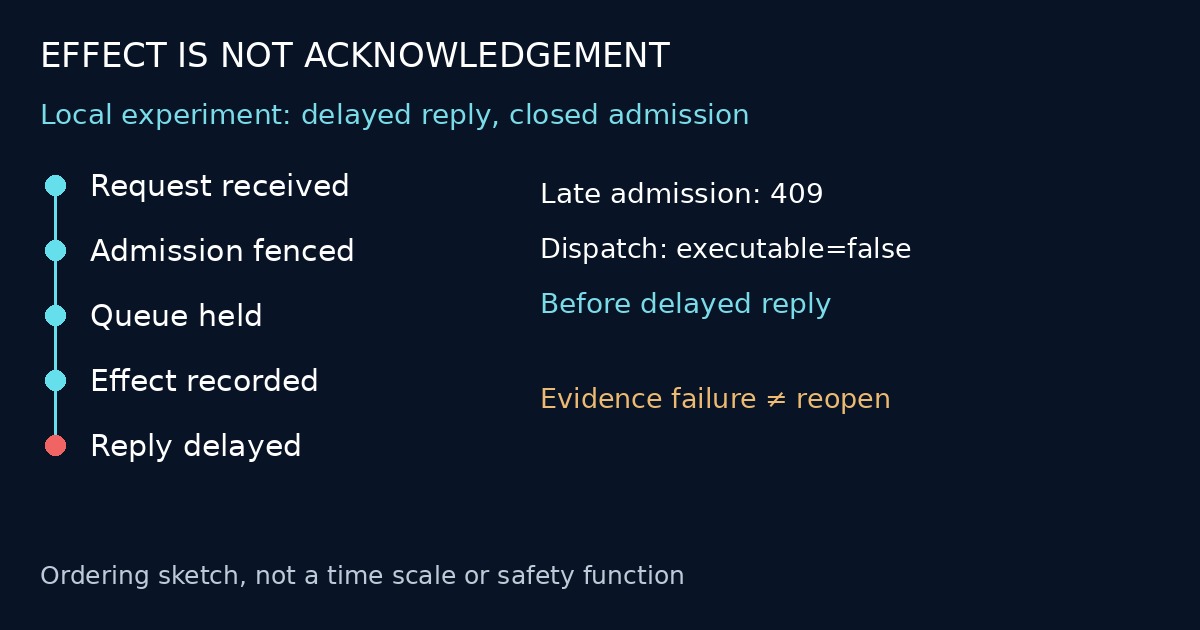
The evidence-failure scenario injected a failed evidence result while retaining the closed gate. It did not take down a real database or test disk exhaustion. Its assertion is intentionally limited: recording failure must not silently reopen admission, and the response must expose missing evidence. A production test must additionally exercise the actual durable sink, bounded retry behaviour, process loss and independent incident notification.
The script's state transition is deliberately small: authorise role and scope; lock shared state; set fenced=true; remove executable queue entries; record effective state; expose the evidence outcome; optionally delay the acknowledgement. Admission and dispatch read the same fence under the same lock. That ordering is reproducible in a local test, but one lock cannot coordinate a fleet. A distributed deployment needs an authoritative fencing mechanism and worker acknowledgements whose failure semantics you have tested.
Keep the dependency and role ownership explicit
Assign the operator permission to request intervention only within the supported deployment scope. Assign the platform owner responsibility for management-path reachability, the service owner responsibility for admission and dispatch enforcement, and the incident lead responsibility for unresolved actions and missing evidence. Assign restart to a named authority distinct from an automatic recovery loop. Record actual people or organisational roles in the restricted operating pack, not public telemetry.
Test the role that will be on shift, not an administrator account that bypasses the intended boundary. Role-based AI literacy and access control addresses preparedness and entitlement. It does not prove that a trained operator can reach a control during an outage. Conversely, a reachable control does not prove good judgment; automation-bias interface evaluation evaluates a different failure mode.
Retain a dependency matrix in the acceptance pack: ordinary UI and session, management transport and credential, shared state authority, worker enforcement, evidence sink and restart owner. For each entry name the failure injected, expected residual capability, test result and escalation owner. If both paths share a proxy, identity backend, host or state store, record that common failure explicitly. Do not label the whole architecture independent because two URLs differ.
Acceptance checklist for the actual deployment
Check 1 — Freeze the permitted advisory task, scope, operator role, software revisions and intervention meaning. Set local timing and escalation limits from the consequence of delayed intervention. Do not copy the fixture's 150 ms stimulus as a service commitment.
Check 2 — Break the ordinary UI route and expire its real session in an approved test environment. Use the normal operator workstation and management access procedure. Verify both receipt and enforcement without granting administrator privileges. Include DNS, proxy and identity dependencies where they belong in the declared failure model.
Check 3 — Race new admissions and queue dispatch against the intervention boundary. Include all workers, reused connections and retrying clients. Verify no new executable advice escapes after the agreed boundary. Account separately for work already running; this local fixture has none.
Check 4 — Delay or lose the acknowledgement. Query state by intervention identity and exercise idempotent retry. Test management-path failure too: an unavailable channel requires an explicit unresolved result and an owned escalation, never a green success indicator. The local experiment covers delayed, not lost, responses.
Check 5 — Fail the actual evidence sink and restart the relevant process. Check whether the fence survives, where missing records are surfaced and who can authorise recovery. A crash that restores an open default invalidates the acceptance result. The local in-memory fixture does not establish persistence.
Check 6 — Try wrong role, wrong scope, revoked credentials and unauthorised restart. Exercise the approved recovery path separately. A permanently unavailable restart may avoid reopening, but it is not a maintainable operating procedure. Review held advice for staleness before any deliberate replay.
The cost of a second channel
A separate management path adds credentials, monitoring, deployment work and operator training. Stronger separation reduces some common-mode failures while increasing attack surface and maintenance burden. A lightly maintained backup channel may be less trustworthy than a well-tested primary one. Restrict access and exercise it on relevant changes to identity, ingress, worker topology or state semantics.
Failing closed also has a cost: delayed advice, manual workload and potentially stale queued decisions. Make those consequences visible to the business owner. Do not solve them by silently reopening admission when logging fails or a timeout expires. Define a manual service alternative and a reviewed restart decision.
Nothing here replaces an engineered emergency stop, safety instrumented system or functional-safety assessment. Do not run these faults against machinery, critical infrastructure or production business actions. The useful first deliverable is a reproducible intervention test for a bounded advisory workflow, followed by environment-specific validation with the responsible engineering and legal specialists.
Bring the unreachable control to review
For an implementation review, bring one operator procedure, its dependency map, the admission/dispatch contract and a case where the current interface cannot confirm intervention. I can help turn that gap into a scoped fault experiment, an effect-verification record and a restart ownership model. The release decision should say which failures the channel tolerates—and which still leave intervention unresolved.