BLUF: Industrial AIOps incident automation works when it narrows the scope: correlate noisy telemetry, classify probable impact, assemble evidence, propose a runbook action, and stop at an approval gate before changing production systems. It fails when teams ask a general-purpose agent to “fix incidents” without service ownership, rollback paths, or measurable safety limits.
For industrial operators, the practical goal is not full autonomy. The first useful target is a controlled incident workflow that reduces mean time to acknowledge, removes copy-and-paste diagnostics, and gives maintenance, OT, IT, and management the same evidence packet.
Why industrial incident response is a good AIOps use case
Industrial environments combine OT signals, network telemetry, MES/ERP context, maintenance tickets, and vendor documentation. Humans are good at judgment, but weak at repeatedly joining these sources under time pressure. AIOps is useful when it does the mechanical work: deduplicate alerts, cluster related symptoms, retrieve known failure modes, and prepare a recommended next action.
Google SRE guidance is a useful baseline: monitoring output should be actionable, and toil is manual, repetitive, automatable work that scales with system size. Industrial incident response contains exactly that pattern: the same log queries, asset checks, escalation messages, screenshots, and runbook lookups happen again and again.
Classic monitoring, AIOps, and agentic automation: comparison matrix
| Approach | Best fit | Automation level | Main risk |
|---|---|---|---|
| Classic monitoring | Known thresholds and clear ownership | Alert, ticket, dashboard | Alert fatigue and missed context |
| AIOps correlation | Many noisy signals across plants, networks, and applications | Event grouping, anomaly hints, probable cause ranking | False correlations if topology and asset context are weak |
| Agentic incident automation | Repeated diagnostic workflows with known runbooks | Tool calls, evidence packet, approval gate, ticket update | Unsafe action if permissions, rollback, and human review are not enforced |
| Autonomous remediation | Low-risk, reversible actions with strong tests | Execute predefined action automatically | Hidden dependency or production side effect |
Reference architecture: controlled AIOps incident automation
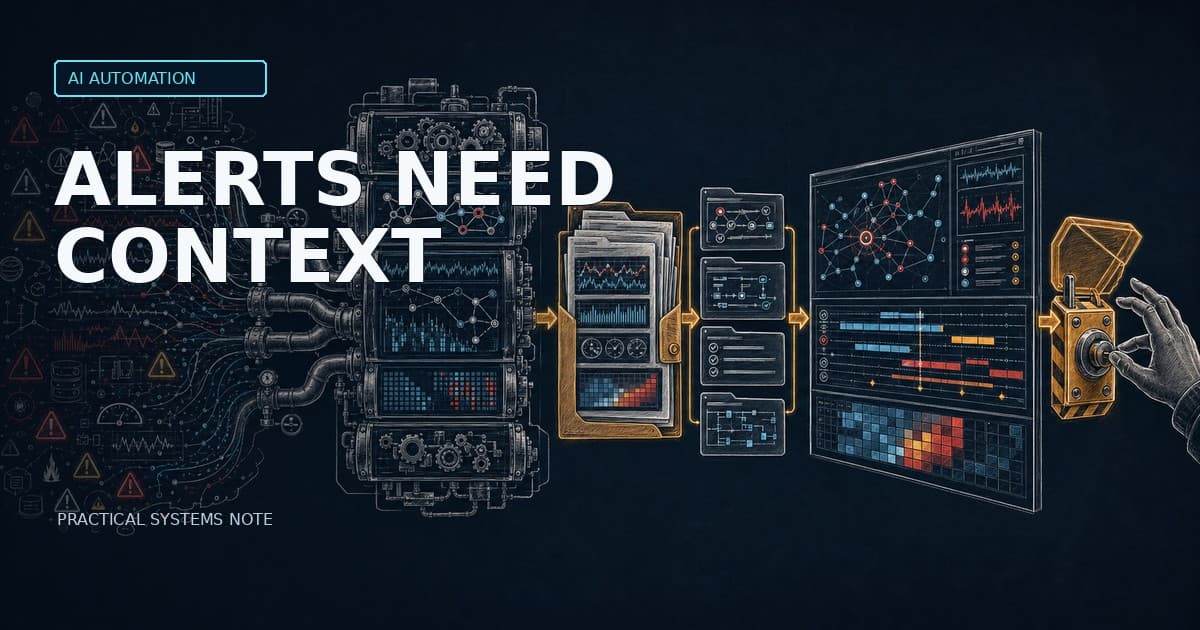
Diagram in words: telemetry sources feed an event bus; an AIOps correlation layer groups symptoms; a retrieval layer pulls runbooks, topology, known errors, and maintenance history; an agent workflow executes read-only diagnostics; a policy gate checks risk; a human approver authorizes any write action; observability captures traces, tool calls, costs, latency, and final outcome.
The architecture should separate observation, diagnosis, recommendation, and execution. Observation can be highly automated. Diagnosis can be assisted. Recommendation should be evidence-based. Execution should start with human approval unless the action is low-risk, reversible, and already proven by incident history.
What the agent should actually do
1. Normalize the alert: service, asset, line, severity, affected users or production cell, timestamp, and duplicate events.
2. Retrieve context: topology, recent deployments, maintenance windows, past incidents, vendor manuals, runbooks, and known-error records.
3. Run read-only diagnostics: health checks, log queries, configuration diffs, network reachability, queue depth, sensor drift, and dependency status.
4. Build an evidence packet: symptoms, likely cause, confidence, missing evidence, recommended action, blast radius, rollback path, and approval owner.
5. Update the operational system of record: incident ticket, timeline, linked dashboards, decisions, approvals, and post-incident learnings.
Where to draw the automation boundary
A safe default is: read-only diagnostics without approval; low-risk reversible actions with policy approval; production write actions only after human approval; safety-related OT actions outside the agent boundary unless explicitly engineered, tested, and legally reviewed.
This boundary matters because industrial incidents can affect physical processes, safety, customer commitments, and regulatory evidence. The AI component should not become an unlogged side channel around change management.
Implementation checklist
Scope one incident class first: for example PLC communication loss, MES queue backlog, machine-data ingestion failure, or VPN instability between plant and cloud.
Define service ownership: who approves actions, who receives escalation, who can close the incident, and who owns the runbook.
Instrument the workflow: every alert, retrieval, tool call, recommendation, approval, command, rollback, and ticket update needs a trace ID.
Create evaluation sets from historic incidents: expected classification, relevant evidence, correct runbook, escalation path, and unacceptable actions.
Start with shadow mode: let the agent produce evidence packets while humans continue normal incident handling. Compare time saved, missing context, false confidence, and operator trust.
Promote gradually: move from evidence packet to suggested action, then to approved action, then to limited autonomous remediation for reversible tasks only.
Metrics that matter in production
Measure mean time to acknowledge, mean time to diagnose, evidence completeness, runbook selection accuracy, false correlation rate, escalation rate, approval rejection rate, rollback frequency, and cost per incident workflow. Model accuracy alone is not enough.
Also track negative controls: how often the agent refuses action, how often it detects missing telemetry, and how often a human corrects the recommendation. These signals tell you whether the automation is becoming safer or merely faster.
Failure modes and mitigations
Weak asset context creates confident but wrong correlations. Mitigation: maintain topology, ownership, and dependency data as production assets.
Unbounded tool access turns a diagnostic assistant into an operational risk. Mitigation: use least privilege, separate read and write credentials, require approval gates, and keep command allow-lists.
Runbooks become stale. Mitigation: connect incident closure to runbook updates and evaluate agents against recent incidents, not only synthetic examples.
Operator trust can collapse after one unsafe recommendation. Mitigation: show evidence, uncertainty, missing information, and rollback steps in every recommendation.
Sources and operating assumptions
Sources: Google SRE Book on monitoring output, incident management, and eliminating toil; Google Cloud guidance on tracking toil with SRE principles; NIST AI Risk Management Framework 1.0 for govern-map-measure-manage risk framing; Gartner/PagerDuty “Predicts 2026” summary on AI agents in IT infrastructure and operations. These sources support the engineering pattern, not a claim that every incident should be automated.
This article is engineering guidance, not legal advice. Industrial AI and OT environments may require safety, labor, data-protection, and sector-specific review before automated actions are enabled.
How I would start with a client
I would not begin with an autonomous agent. I would select one costly recurring incident class, map the telemetry and ownership, build a read-only diagnostic workflow, evaluate it against historic incidents, then add approval-gated remediation only where rollback is clear. That produces measurable value without pretending that plant operations can be delegated to a black box.