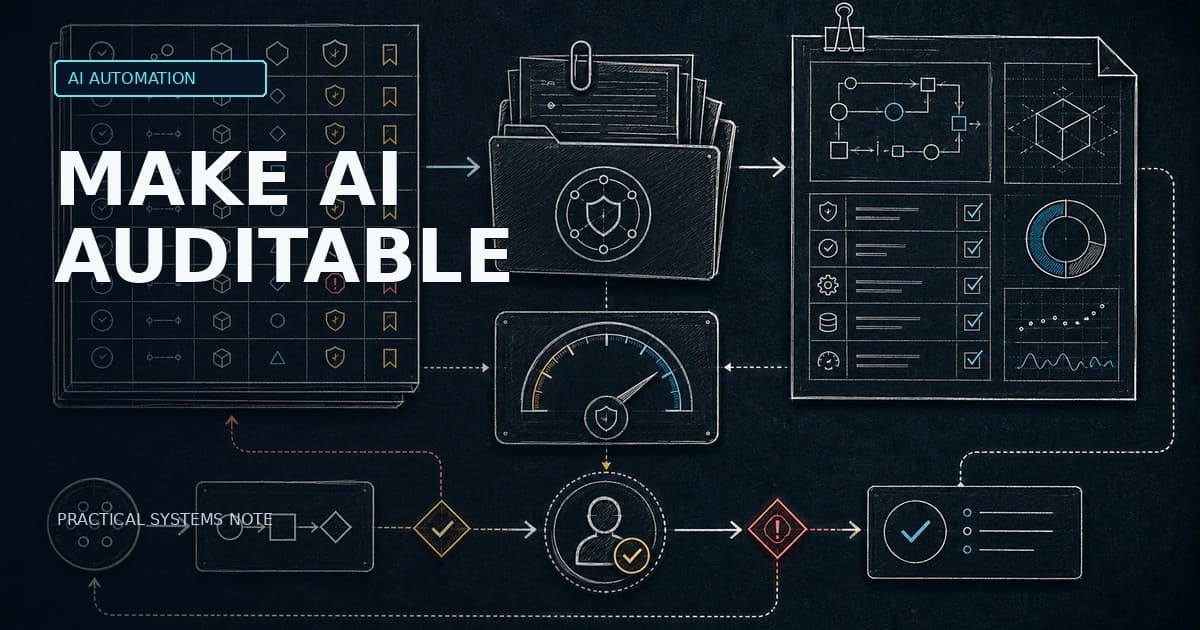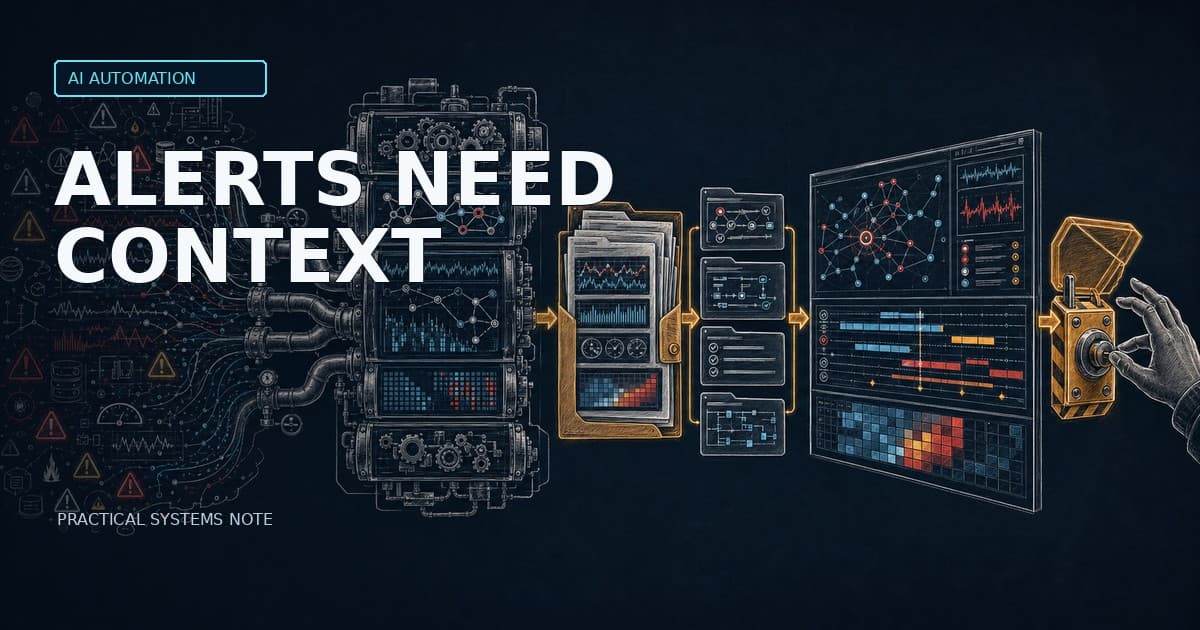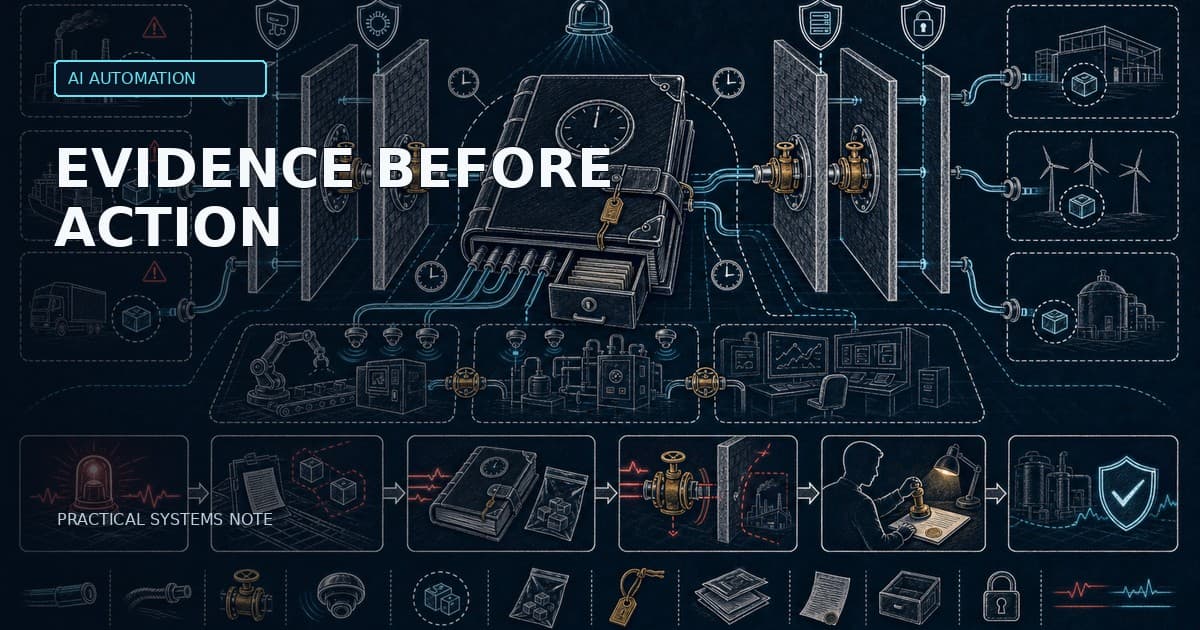
BLUF: NIS2-ready AI operations are not achieved by adding an AI assistant to the SOC or NOC. They require an evidence-producing operating model: every AI suggestion must be traceable to telemetry, every supplier action must be bounded by contracts and access controls, and every network change must pass an approval path that can be reconstructed after an incident.
This article is engineering guidance, not legal advice. Whether your organisation is in scope as an essential or important entity, and how national implementation applies, should be reviewed with qualified legal counsel. The technical point is narrower: if AI is used in operations, the system must make cybersecurity risk management, incident reporting, supplier control, and management accountability easier to evidence—not harder.
Why NIS2 changes the AI operations architecture
The European Commission describes NIS2 as a unified legal framework for cybersecurity across 18 critical sectors. It introduces risk-management measures, reporting requirements, supply-chain security expectations, stronger supervision, and top-management accountability. For engineering teams, this pushes AI operations away from informal chat-driven troubleshooting and toward auditable workflows.
The failure mode is familiar: an AI agent summarises alerts, proposes a firewall change, opens a supplier ticket, or drafts an incident report. The action may be technically useful, but the organisation later cannot prove which data the agent used, who approved the action, whether supplier access was justified, or how the decision timeline fits incident reporting obligations.
Reference architecture: evidence first, automation second
A practical NIS2-ready AI operations stack has five layers. First, collect immutable telemetry from SIEM, EDR, network devices, identity systems, ticketing, and cloud control planes. Second, normalise events into an incident workspace with asset criticality, supplier ownership, affected business process, and severity. Third, let AI classify, summarise, correlate, and recommend—but require citations to source events and confidence thresholds. Fourth, route risky actions through human approval gates. Fifth, export an evidence pack: timeline, data sources, model output, approvals, changes, supplier contacts, and post-incident actions.
The design principle is simple: the AI layer should never be the only place where incident knowledge exists. It can accelerate triage and documentation, but the canonical record belongs in systems that security, operations, compliance, and management can audit.
Control matrix for NIS2-ready AI operations
| Area | What the AI system may do | Required control | Evidence to retain |
|---|---|---|---|
| Incident triage | Cluster alerts, summarise likely impact, draft severity rationale | Cite source events, preserve prompts and outputs, keep analyst override | Timeline, alert IDs, affected assets, analyst decision |
| Network controls | Propose segmentation, firewall, identity, or rate-limit changes | Human approval before production change, rollback plan, change window | Change request, approval, diff, deployment result, rollback evidence |
| Supplier handling | Identify responsible supplier or managed-service provider, draft ticket text | Contract-bound access, least privilege, named contact, scope limit | Supplier ticket, access grant, expiry, actions performed |
| Reporting support | Draft management and authority-ready summaries | Legal/compliance review before external submission | Draft versions, reviewer comments, submission timestamp |
| Post-incident learning | Generate lessons learned and control improvements | Owner assignment and deadline tracking | Remediation backlog, control test result, management sign-off |
Incident evidence: make the audit trail boring
The incident evidence pack should be generated continuously, not assembled under pressure after the event. At minimum, capture incident ID, start time, detection source, severity changes, affected assets, business impact assumption, AI recommendations, human decisions, executed actions, supplier interactions, and final remediation status.
For AI outputs, retain the prompt template version, model/provider, retrieval context or cited event IDs, output text, confidence or evaluation score if used, approver identity, and rejection reason where applicable. This is not bureaucracy for its own sake. It is how teams distinguish between “the AI said so” and “the operator approved a cited recommendation based on these telemetry events”.
Supplier risk: AI makes third-party boundaries visible
NIS2 explicitly raises the importance of supply-chain and supplier security. In AI operations, supplier risk appears in two places: external providers that receive incident data, and suppliers whose systems are part of the remediation path. Both need technical boundaries.
Use short-lived supplier access, scoped roles, ticket-linked approvals, redaction for unnecessary personal or customer data, and automatic expiry. If an AI agent drafts supplier tickets, the agent should classify which data may be shared, but a human should approve disclosure for sensitive incidents. Supplier portals and managed-service accounts should be logged as first-class incident actors, not as informal side channels.
Network controls: do not let the agent become a change system
Network changes are where AI operations can move from helpful to dangerous. Let the agent analyse blast radius, compare proposed rules with policy, identify missing segmentation, and draft rollback steps. Do not allow unattended production changes unless the action is low-risk, pre-approved, reversible, and continuously monitored. Most German B2B environments should start with read-only recommendations plus ticket creation.
A good pattern is “recommend, simulate, approve, execute, verify”. The agent recommends a control, the system simulates or checks policy impact, an accountable person approves, automation executes via an existing change path, and verification confirms that the intended control is active without unexpected side effects.
Implementation checklist
1. Map whether AI operations touch NIS2-relevant processes, suppliers, or critical services. Separate legal scoping from technical readiness.
2. Define which AI actions are read-only, draft-only, approval-required, or forbidden. Document this as an operational policy, not only as code.
3. Build the incident evidence schema before adding autonomous remediation. If the evidence model is weak, automation will amplify ambiguity.
4. Integrate supplier access with ticket IDs, expiry, least privilege, and named ownership. Avoid shared emergency accounts.
5. Put network-control changes behind simulation, peer review, rollback, and post-change verification.
6. Test the system with tabletop exercises: missed alert, false positive, supplier outage, identity compromise, and failed rollback.
Where automation helps immediately
The highest-value first use cases are not autonomous fixes. They are evidence collation, alert clustering, impact summaries, supplier-ticket drafts, duplicate incident detection, and management-ready situation updates. These reduce manual work while keeping accountability clear.
More autonomous actions can follow once the organisation has reliable telemetry, documented approval classes, deterministic rollback paths, and measured false-positive rates. Without those foundations, AI makes incident response faster but less defensible.
Sources
European Commission, NIS2 Directive overview: NIS2 establishes a cybersecurity framework across 18 critical sectors, with risk-management measures, reporting requirements, supply-chain security, supervision, enforcement, and management accountability. https://digital-strategy.ec.europa.eu/en/policies/nis2-directive
Directive (EU) 2022/2555: the primary legal text for measures for a high common level of cybersecurity across the Union. https://eur-lex.europa.eu/eli/dir/2022/2555
BSI NIS2 information for regulated companies: registration, project roadmap phases, and German implementation context. https://www.bsi.bund.de/DE/Themen/Regulierte-Wirtschaft/NIS-2-regulierte-Unternehmen/nis-2-regulierte-unternehmen_node.html
How I help
If you are introducing AI into security, network, or industrial operations, I help design the control architecture: telemetry model, approval gates, supplier boundaries, evidence packs, and pragmatic automation paths. The goal is not a flashy agent demo. It is an AI operations system that stands up during real incidents, audits, and management reviews.