
Deleting vectors is not enough to keep withdrawn evidence out of a RAG system. A restored snapshot, delayed ingestion worker or cached answer can bring it back. Keep the current withdrawal decision outside the index recovery boundary, enforce it before evidence reaches the model, and quarantine restored collections until reconciliation completes. Treat retrieval denial and storage cleanup as separate outcomes: neither a successful delete response nor an empty search result proves physical erasure.
The race a successful delete does not settle
Consider a synthetic maintenance manual A at generation 1. A worker reads it and starts embedding. An operator then withdraws A; the index deletes its chunks. The worker finishes and upserts those same chunks. Alternatively, a snapshot taken before withdrawal replaces the cleaned collection. Both paths can recreate a record that yesterday's deletion job successfully removed.
The existing RAG data-governance guide establishes classification, retention and revocation. This implementation adds the missing recovery decision: which current authority can reject evidence when the searchable store has moved backward? Unlike an ordinary cleanup retry, that authority must survive the restore itself.
Qdrant's point documentation describes deletion, upserts, operation completion and conditional updates. Those mechanisms are useful building blocks; they do not make an application withdrawal ledger part of every write or read automatically. Qdrant also supports filter-based update preconditions. Check the deployed version and missing-point behavior before using them as a generation fence; a predicate stored only in the restored collection is not an independent withdrawal authority.
Define identity and the denial contract first
Use an immutable key comprising tenant, connector namespace and source object ID. A filename, content hash or chunk offset alone is inadequate: renaming must not create a fresh authorized identity, and two tenants may own identical bytes. Map every chunk, parent document, embedding job and answer-cache dependency back to this key. Keep content digest, document generation and chunking revision separate.
The ledger holds the current monotonic generation, withdrawal flag, decision revision and an idempotent request reference. A withdrawal advances generation and durably records denial before acknowledging enforcement. A repeated request must return the existing decision rather than advance the generation again. Reintroduction requires explicit authorization and a newer generation; an ingestion retry cannot clear the tombstone. Store only the minimum identity and evidence needed, not a second copy of the withdrawn text.
State the guarantee narrowly. After the denial boundary has committed, new retrieval admissions for the withdrawn generation must fail. Work already admitted may have reached the model or an external provider. If the product promises cancellation of in-flight answers, add cancellation and a final output gate; a pre-retrieval check alone cannot retract tokens already streamed. Record the difference between request received, denial committed and all affected in-flight work drained.
Lifecycle: denial first, cleanup independently
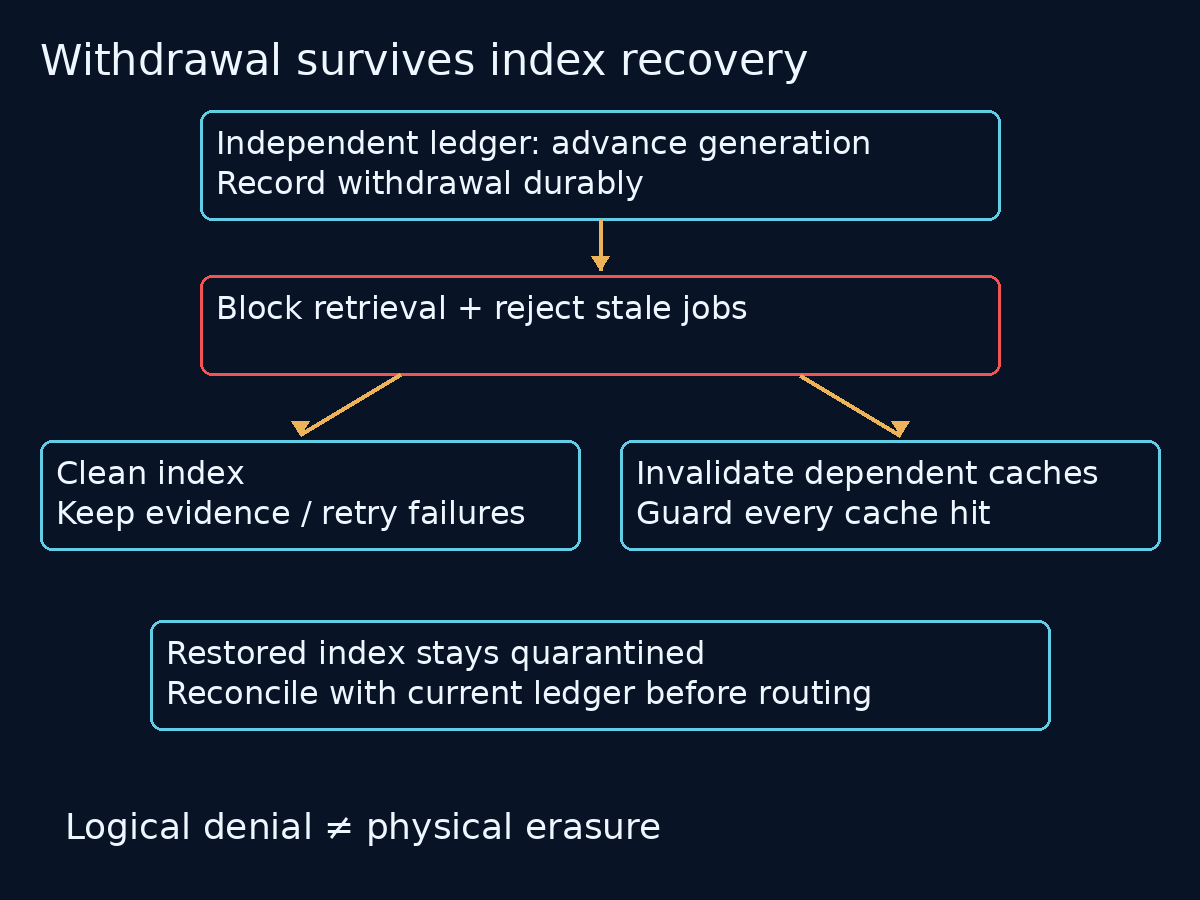
The diagram describes proposed application controls, not built-in vendor guarantees. Index cleanup and cache invalidation are parallel, retryable branches after retrieval is blocked. Restore reconciliation is a separate admission condition, not a claim that storage media have been erased. Keep branch evidence and failures independently visible instead of hiding them behind one completed flag.
| State | Required evidence | What it does not establish |
|---|---|---|
| Delete requested | Stable request and document identity recorded | Queries are already blocked |
| Retrieval blocked | Current ledger denies the generation at the evidence boundary | Old in-flight context has been recalled |
| Index cleaned | Scoped chunk deletion completed and checked | A late writer cannot reinsert data |
| Cache invalidated | Dependent entries removed or denied on every hit | Backup copies or allocator memory are erased |
| Restore reconciled | Current decisions applied before routing to recovered data | All legal erasure obligations are satisfied |
Place the authoritative ledger in a separately protected recovery domain with its own durability, replication and restore procedure. A separate database name is not enough if both databases are restored to the same stale point. Record the latest accepted decision revision outside the recovered index and prove the recovered ledger includes all acknowledged withdrawals. If that proof is missing, hold retrieval closed; absence of a tombstone in an uncertain ledger is not permission.
Fence ingestion without a check-then-write illusion
Carry the document generation in every queued job. Immediately before committing searchable data, require an exact match with a currently authorized ledger generation. Serialize document mutation and withdrawal through a single controlled writer or use an enforceable conditional-write/fencing protocol. All alternate connectors and replay tools must use it. A distributed lock is insufficient if an expired holder can still write; the receiving boundary must reject its stale authority.
A separate ledger read followed by a vector-store upsert is not atomic. Withdrawal can commit in the gap. Where you cannot eliminate that gap across stores, acknowledge the limitation: old points may temporarily exist, but an independent retrieval guard must deny them, and reconciliation must remove them. Do not advertise physical non-reinsertion based on a preflight check. Verify your real database's conditional-write and replica behavior with a deliberately paused worker.
Use tenant-aware routing and metadata filters to narrow candidate search. Before loading parent text, reranking with an external service or building a prompt, batch-check each candidate's identity and generation against current authority. Do not let rejected text enter an external reranker first. Protect direct-ID fetches, keyword search, exports and administrative retrieval too. The multi-tenant RAG isolation guide covers the complementary tenant boundary; withdrawal checks do not replace it.
Cached answers need provenance, not just a TTL
An answer may combine several documents. Store its complete dependency set as document identity plus generation, and validate every dependency before returning a hit. If provenance is absent or incomplete, invalidate the cache namespace or stop serving those entries. An authorization-policy epoch can invalidate a wider namespace efficiently, but it trades hit rate for simpler correctness. Short TTLs merely bound an exposure window; they do not implement immediate withdrawal.
Redis UNLINK removes keys from the keyspace and reclaims their memory asynchronously. That distinction matters: key removal is not a claim about backups, persistence files or forensic erasure. If invalidation fails, the ledger guard must still reject the answer. Revalidate dependencies when writing newly generated answers as well, so a generation that started before withdrawal does not repopulate a trusted cache afterward.
Restore into quarantine, then reconcile
Qdrant's snapshot documentation states that collection snapshots contain collection data, configuration, points and payloads; collection aliases are excluded. Distributed deployments require attention to individual nodes. Choose a recovery procedure appropriate to the actual topology and version; a successful file import is not a release decision.
First provision a non-serving target, disable ingestion and prevent old workers from reconnecting. Restore the selected collection while keeping the live route closed. Load the current authoritative ledger, identify all withdrawn or superseded document generations, and remove those records and dependent cached answers. Verify direct fetches as well as filtered search. Preserve unrelated authorized documents: a cleanup that deletes everything is not a successful recovery test.
Capture a ledger revision for reconciliation, then catch up later decisions before promotion. A one-time scan can race a new withdrawal. Either fence admission while finishing reconciliation or retain a continuously current, fail-closed read guard across the routing switch. Do not declare a stale scan complete while readers bypass the ledger. Record snapshot identity, ledger watermark, target collection, cleanup results, unresolved items and the release decision. The workflow restore-drill guide applies the same isolation principle to business side effects rather than retrieved evidence.
Executed fixture and what it proves
For this article, a synthetic Python state-machine fixture was executed: 10 checks passed, including all six serialized orders of write, withdrawal and cleanup. It uses in-memory dictionaries, not Qdrant or Redis. Docker and redis-server were unavailable in the execution environment; no real-store integration, crash recovery, replication or latency result is claimed.
The model keeps A and B at generation 1, captures an old index snapshot, withdraws A at generation 2 and retains B. Its write operation models atomic admission. A separate negative control intentionally bypasses that operation after a successful preflight check: A physically reappears, but the independent read guard denies it. This demonstrates why preflight checking and physical prevention are different claims, not that production concurrency is solved.
| Injected condition | Observed fixture result | Required production follow-up |
|---|---|---|
| Delayed generation-1 write | Admission rejected after withdrawal | Pause a real connector between check and commit |
| Failed cache invalidation | Cached answer remains stored but is denied | Exercise every cache hit and fill path |
| Old snapshot restored | Queries remain closed until reconciliation | Restore the actual collection and routing layer |
| Ledger unavailable | Reconciliation and retrieval stay closed | Test timeout, stale replica and lost quorum |
| Repeated deletion request | Generation remains 2 | Prove durable idempotency after process restart |
| Explicit generation-3 authorization | Old job rejected; new job accepted | Test source identity reuse and approval controls |
The fixture also checks that B remains retrievable after reconciliation. Passing these assertions validates the modeled decisions only. Before production, repeat them against pinned server and client versions, real persistence, network partitions and concurrent clients. Preserve command output, manifests and negative-control failures with the release evidence.
Acceptance checklist and operational cost
Require a named owner for the ledger, its recovery-point objective and its retention horizon. That horizon must cover every restorable backup, delayed queue, export and offline connector that can reintroduce the identity. Do not garbage-collect tombstones just because the current index is empty. If an older backup remains admissible, the corresponding denial evidence must remain enforceable or that backup must be excluded from service restoration.
Measure request-to-denial separately from index cleanup, cache invalidation and restore reconciliation. Publish the unresolved count and oldest outstanding age, with bounded metric dimensions rather than document IDs as time-series labels. Probe with synthetic canaries through direct fetch, search, cache hit and a delayed worker. A sampled zero-result query is useful evidence but not proof that all copies are gone.
The trade-off is deliberate: an authoritative read guard adds latency, availability coupling and operational state. Batch checks reduce call overhead; cached allow decisions require a freshness and revocation contract. Fail-closed behavior can interrupt legitimate answers during ledger failure. Document that cost instead of silently serving stale evidence. Backups, lawful retention, deletion exceptions and physical erasure require qualified privacy and legal review; this is an engineering pattern, not legal advice.
For a bounded implementation review, bring one connector, one restored snapshot and one answer-cache path. I can help turn those into an identity map, a generation-fencing design and a failure-injection acceptance suite. The deliverable should show where withdrawn evidence is denied after recovery—and where your system still needs stronger guarantees.